
What is a collating machine and why is it indispensable?
Collating machines gather book blocks consisting of multiple sections (called signatures) in the correct order. They are used as a preliminary step for thread sewing (in-line) or adhesive binding (off-line). Because of their pivotal function between printing and folding on the one hand and the subsequent production of the book block blank on the other, the collaborating machine is considered the heart of the finishing process.
The space challenge: More stations in less space
When selecting a suitable collating machine, space requirements play a crucial role for customers – because in many printing plants and print finishing companies, every square meter counts. That’s why Smyth’s collating machine with a 2-in-1 magazine proved to be a true game-changer upon its market launch.
The innovation lies in the halving of the magazines used to load the printed sheets. This allows for twice as many sheets to be accommodated compared to machines without this patented technology, even for formats with a signature spine length of up to 320 mm. When loading two sheets, they are inserted sequentially into the magazines and collated one after the other.
The reduced footprint while handling the same number of signatures is a truly unique selling point.


Technical details & everyday flexibility
The collating machine has a modular design, allowing it to be adapted to the needs and production capacities of individual customers. Even after installation, the machine can be expanded with additional units at any time.
Flexibility is also key when it comes to setup times. Thanks to automated processes, the machine can quickly switch from one production run to the next – even with significantly different formats. In practice, only a few minutes separate the processing of an A4 format from that of a handy paperback. The machine starts automatically as soon as the signatures are positioned in the collating station.


Application scenarios for thread stitching and adhesive binding / COURIER function
The efficiency advantages of Symth machines are particularly evident in in-line applications. With UNIT and CONCEPT, PPL offers two compact, fully automated lines for seamless, timed industrial book production, combining collating sheets and thread stitching in a single solution.
The COURIER function allows you to feed the in-line stitcher while simultaneously diverting blocks for external off-line processing. This effectively doubles the output.
The collating machine can also be used off-line for perfect binding in smaller print runs. In this context, they offer a high degree of flexibility for varying job requirements.
Paper conservation through vertical feeding
Another advantage of Smyth’s 2-in-1 collating machine is its gentle handling of signatures. Unlike machines from other manufacturers, the vertical arrangement of the signatures reduces the weight on the first signatures collected. Because the paper also has less contact with surfaces overall, the collating process leaves no marks on delicate digital prints.
From an ergonomic perspective, Smyth’s patented solution is also a significant step forward: it makes loading the magazines easier. A signature support plate with an adjustable angle further facilitates handling of all types of signatures.
Maximum capacity: One operator, two output paths
The efficiency of Smyth’s 2-in-1 collating machine also impacts staffing requirements: the entire collating and stapling line can be operated by a single person. The CONCEPT series offers additional cost advantages from the ability to simultaneously staple (in-line) and stack (off-line).
Zero-defect tolerance: Control systems & PPL solutions
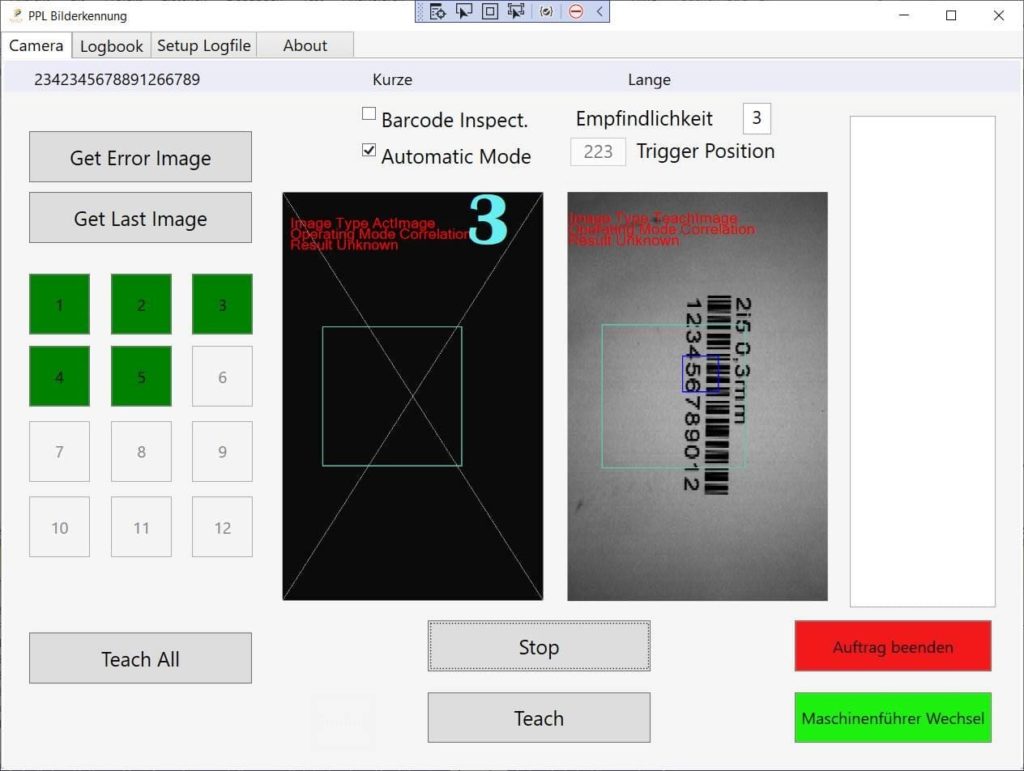
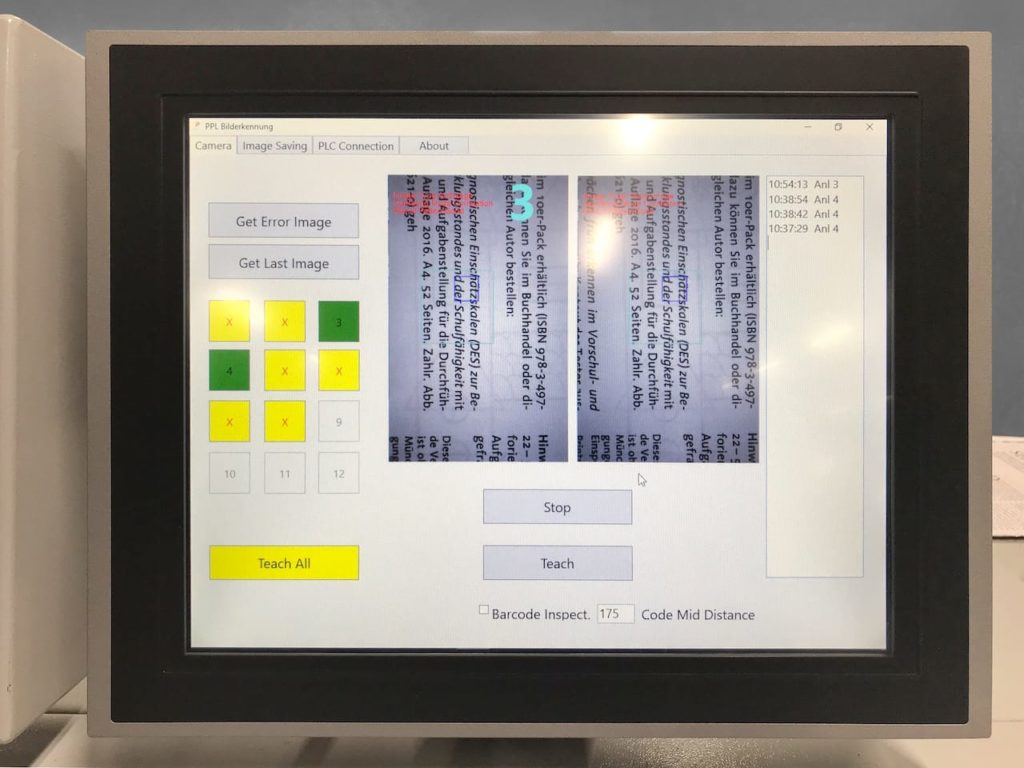
To minimize the number of misprints and duplicate sheets, Smyth machines are equipped with standard quality control systems. Even greater reliability is achieved through integration with the PPL camera system for image matching and barcode verification, eliminating errors completely. The system can be integrated during initial installation or retrofitted at a later date.
After a paper jam, special transport fingers allow for immediate restart with minimal downtime. Excess sheets are handled via the integrated manual feeder, which is standard equipment.
Conclusion: Advice and availability at PPL
Ease of use, paper conservation, and space requirements: The Smyth 2-in-1 collating machine excels in all relevant categories. One-person operation combined with maximum process reliability also allows for extremely efficient operation.
We at PPL have been Smyth’s German sales partner for many years and would be happy to advise you on the optimal configuration for your downstream processing needs. As the developers of the complementary camera control system, we are also proven experts in monitoring and process reliability.
Are you looking for a collating machine that grows with your requirements? Ask us about the Smyth UNIT or CONCEPT series.
Häufige Fragen:
Collating machines gather book blocks consisting of several sections (so-called signatures) for thread stitching and adhesive binding.
Smyth’s patented solution is suitable for the production of small to medium print runs.
Smyth has halved or divided the magazines for the printed sheets – thereby doubling the loading capacity. This allows twice as many sheets to be accommodated for formats with a signature spine length of up to 320 mm.
Yes, for example with the UNIT and CONCEPT lines. The efficiency advantages of the 2-in-1 collating machine are particularly evident in compact, fully automated lines for industrial book production.